The Customer Journey Starts Before The Phone Rings

By the time a customer reaches your contact centre, they’ve probably already been on quite a journey. They may have searched your website, browsed the FAQs, tried the chatbot, searched online for an answer, abandoned the process altogether and then come back later. Only after exhausting those options do many people decide to pick up the phone.
To the customer, it’s one continuous experience. They’re simply trying to solve a problem. To the organisation, however, it often appears as a single interaction beginning the moment an advisor answers the call.
During my conversation with Helen Pettifer from Helen Pettifer Training Ltd, this became one of the most interesting themes we discussed. Organisations naturally focus on the interaction they can see, but the customer’s experience usually starts long before that first conversation with a human. As Helen explained, by the time someone finally reaches an advisor, they’re often bringing with them everything that has already happened.
A typical journey might look something like this:
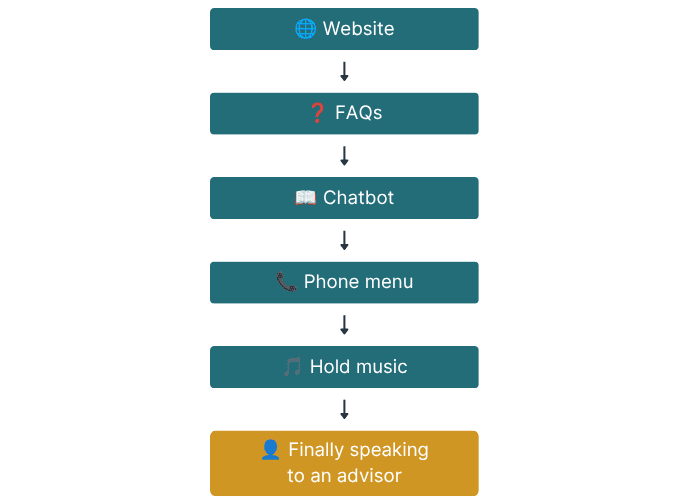
The important point isn’t the order of those interactions. It’s that the customer sees them as one journey, while the organisation often experiences them as a series of separate events. Different systems, different channels and sometimes different teams all become responsible for small parts of the experience, with very little understanding of what came before.
That disconnect shapes the conversation before it’s even begun. A customer who has already spent twenty minutes trying to find an answer arrives frustrated, while the advisor may have no visibility of the effort that’s already gone into solving the problem. The result is one of the most common frustrations in customer service: having to explain everything all over again.
Helen believes this is where AI has the opportunity to make a meaningful difference. Rather than simply automating another interaction, it can help connect the ones that have already happened. A chatbot conversation can be summarised before it’s passed to an advisor, previous interactions can provide context, and the next conversation can continue the journey instead of starting from scratch.
It’s a subtle shift in thinking. Much of the discussion around AI focuses on efficiency or automation, but perhaps one of its greatest strengths is helping organisations see customer journeys in the same way customers experience them: as one connected story rather than a collection of disconnected moments.
Because by the time the phone rings, the journey has already begun.
Image sources
- flow diagram-700: flow diagram
- travel journey-1200: ©Airam Dato-on from Pexels via Canva.com