When Productivity Isn’t Enough

For much of the conversation around AI, productivity has become the headline metric.
We measure hours saved, tasks automated and efficiencies gained. Organisations invest in AI because it promises to help people do more, faster, and for the most part, that seems like an obvious step forward.
During my conversation with Cyrus Mehta from Perform to Succeed, however, he said something that stopped me in my tracks.
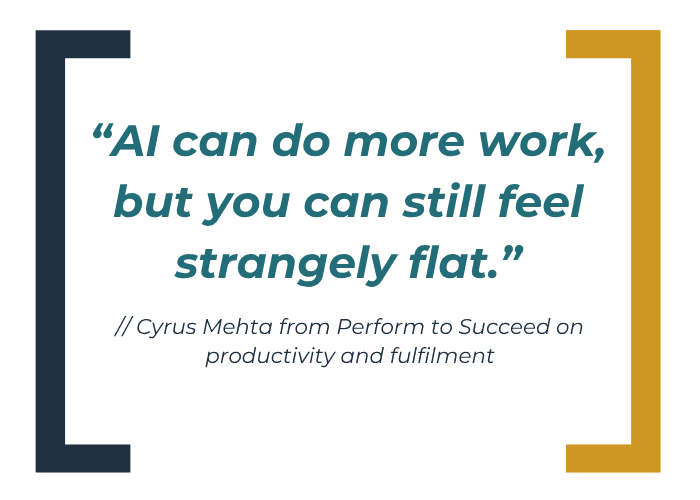
It’s a simple sentence, but it captures something we don’t often talk about. Productivity and fulfilment are not necessarily the same thing.
More Output Doesn’t Always Mean More Satisfaction
It’s easy to assume that removing work people don’t enjoy will automatically improve their jobs. If AI can produce reports in seconds, automate administration or complete routine tasks, surely everyone benefits.
Cyrus challenged that assumption. He argued that becoming more productive doesn’t automatically make work more fulfilling because people are motivated by very different things. Someone who enjoys solving problems may welcome AI taking repetitive tasks away. Someone else may find satisfaction in becoming the recognised expert, building deep knowledge or simply mastering a familiar routine. If AI changes those parts of the role, it isn’t just changing the work. It is changing the experience of doing that work.
That feels like a subtle but important distinction. We often talk about AI changing jobs, yet jobs are made up of much more than tasks. They’re made up of routines, relationships, expertise, confidence and purpose. Change those things, and the role may still exist on paper while feeling completely different to the person doing it.
Looking Beyond Productivity
One of the reasons this matters is because productivity is relatively easy to measure. Organisations can calculate hours saved, reports generated or processes automated. Those metrics help demonstrate return on investment, making them an obvious way to judge whether an AI project has been successful.
What they don’t tell us is whether people are still engaged and finding the same or better sense of satisfaction in their work. Someone may produce more in a day than they ever could before and still finish feeling strangely disconnected from what they’ve achieved. The numbers suggest success, but the human experience tells a more complicated story. As Cyrus observed, it’s entirely possible for AI to do more work while the person doing the job feels unexpectedly flat.
Perhaps that’s the challenge many organisations are only beginning to recognise. AI adoption is often measured through dashboards, usage statistics and efficiency gains, yet very few organisations ask whether people are finding the same meaning in their work after those changes have been made. If motivation quietly begins to decline while productivity continues to rise, traditional measures of success may never reveal it.
A More Human Measure Of Success
This doesn’t mean organisations should slow down their adoption of AI. The potential benefits are real, and in many cases AI will remove genuinely frustrating, repetitive tasks that few people will miss.
The challenge is recognising that work is about more than output. Different people are motivated by different things, and what feels like progress for one employee may feel like loss for another. For some, AI creates more space for creativity and problem-solving, for others, it may change the very aspects of work that gave them confidence, purpose or a sense of achievement in the first place.
Perhaps that’s why Cyrus’s observation stayed with me long after our conversation ended. It reminds us that successful AI adoption isn’t simply about helping people do more, it’s about making sure they remain engaged and driven to perform well at the work they’re doing.
Image sources
- cyrus mehta feeling quote-700: ©Cyrus Mehta interview with Decoded Thinking
- sad post it-1200: ©Christopher Welsch Leveroni from Pexels via Canva.com