Should we trust decisions we can’t explain?

It usually starts with something small. A recommendation you follow without thinking, or a suggestion that feels right even if you’re not quite sure why. You accept it, move on, and don’t question it. Most of the time, there’s no reason to. But the same pattern shows up in bigger decisions too, and at that point, the lack of explanation starts to feel different.
When “working” isn’t enough to explain it
AI has followed a similar pattern. If a system produces a helpful response, makes a good recommendation, or improves efficiency, that’s often enough to justify its use. The process behind it stays in the background.
That logic starts to shift when decisions move from being helpful to being consequential. At that point, the question changes. Not “does it work?” but “can we understand why it worked?”
That shift is already starting to show up in how people respond to AI.
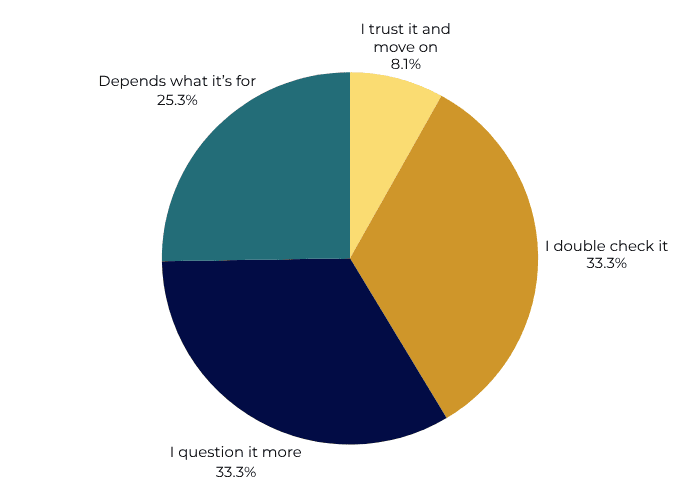
Part of the challenge is that many AI systems aren’t easy to explain. They learn patterns from large amounts of data, adjusting internal parameters in ways that don’t translate neatly into human reasoning. The result is something that can produce accurate outputs without offering a clear account of how it got there.
When decisions start to matter
That acceptance becomes harder when the stakes increase. If an AI system influences whether someone gets a loan, how a patient is prioritised, or whether an application is successful, the outcome starts to carry weight. It affects real people in real ways.
In those moments, explanation becomes more than a nice-to-have. It becomes part of what makes a decision feel fair. Being able to understand, question, or challenge an outcome starts to matter just as much as the outcome itself.
The role of explainable AI
This is where explainable AI, often referred to as XAI, comes into the conversation. The aim is simple in principle: to make AI systems more transparent, or at least more interpretable. That might mean highlighting which factors influenced a decision or offering a simplified version of how the system reached its conclusion.
It doesn’t necessarily make the system fully understandable, but it brings it closer to something that can be examined rather than simply accepted.
The trade-off no one really talks about
The challenge is that explanation and performance don’t always align. Some of the most powerful AI models are also the hardest to interpret. Their strength comes from their complexity, from the fact that they can capture patterns that are difficult for humans to articulate.
Trying to simplify that can reduce their effectiveness. So there’s a trade-off. Do we prioritise systems that perform well, even if we don’t fully understand them? Or do we accept slightly less accurate systems in exchange for greater transparency? There isn’t a clear answer, and most organisations are trying to balance both.
Why we only notice when something goes wrong
In practice, most people don’t think about this trade-off until something goes wrong. We rely on systems every day without questioning how they work. Recommendations, rankings, automated decisions all become part of the background.
It’s only when something feels unfair, unexpected, or incorrect that the need for explanation becomes urgent. By that point, it can be difficult to get, especially if the system wasn’t designed with explanation in mind.
Who is really making the decision?
There’s also a more subtle shift happening. As AI becomes more embedded in everyday systems, the line between human and machine decision-making starts to blur. Decisions are no longer made entirely by one or the other, but through a combination of both.
A system might filter options, rank choices, or suggest outcomes, with a person making the final call. But if the system’s reasoning isn’t clear, it raises a question about where the decision is actually coming from, and how much influence sits with something we don’t fully understand.
Trust without understanding?
This isn’t about rejecting AI. In many cases, these systems do improve outcomes. They can process more information, identify patterns more quickly, and support better decisions than humans alone.
The question is how we relate to those decisions. Whether we treat them as tools to be questioned, or outputs to be accepted. Trust becomes more complicated when the reasoning isn’t visible, especially in situations where the stakes are higher and the consequences more personal.
Where this leaves us
So the question isn’t just whether AI systems can be explained. It’s where explanation becomes necessary, and at what point “it works” stops being enough.
When decisions start to affect people in meaningful ways, is trust something that can exist without understanding?
Image sources
- what happens next-700: poll - When AI gives you an answer instantly, what happens next pie chart
- many question marks-1200: ©Noppol Mahawanjam via Canva.com