AI Verifying AI
What happens when organisations can no longer trust digital evidence?
For years, organisations have relied on digital evidence to make decisions. A photograph of a damaged vehicle, a doctor’s note supporting a refund, an image attached to an insurance claim or a video submitted as evidence all carry an assumption that what we’re looking at is genuine. Digital evidence has become part of everyday business, and for the most part, we’ve trusted it.
During a recent conversation, Brian Feeney from Humanly, challenged that assumption with a statement that stopped me in my tracks.
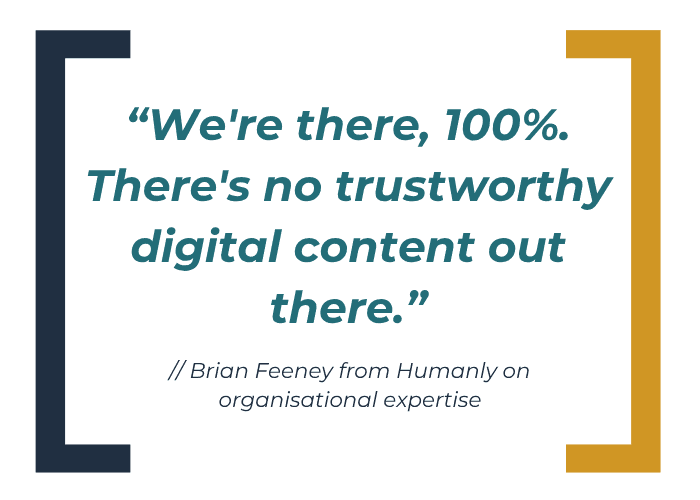
It’s a bold claim, but the more we spoke, the more difficult it became to dismiss.
The Trust Problem
When discussions about AI-generated fraud make the headlines, they often focus on sophisticated cybercrime or highly organised criminal networks. The reality, however, is becoming much more ordinary. Brian described people generating doctor’s notes to claim refunds on flights, manipulating photographs to exaggerate insurance damage, altering images to support retail returns and even making themselves appear eligible for weight-loss medication by using AI to change their appearance.
The important point isn’t that these examples exist. It’s that the technology needed to create them is no longer limited to specialists. You no longer need advanced editing skills or expensive software. Increasingly, you simply need access to an AI model and a well-worded prompt.
That creates a much bigger challenge for organisations than simply identifying fraud. It changes the nature of digital evidence itself.
Beyond Human Detection
For years, businesses have assumed that people reviewing claims, documents and photographs could use their experience and judgement to identify when something didn’t look quite right. That assumption becomes much harder to defend if the evidence itself can be created or manipulated so convincingly that even experts struggle to tell the difference.
Brian described a simple image quiz Humanly uses to demonstrate the problem. Participants are asked to identify whether images are genuine or AI-generated. Even people with extensive experience working with digital imagery rarely achieve perfect scores. In fact, Brian admitted that even members of his own team don’t always identify every image correctly.
If specialists struggle, what does that mean for the insurance claims handler reviewing hundreds of photographs every day? Or the fraud investigator working through a growing queue of customer evidence? Or the retailer making quick decisions about returns? The issue is no longer simply spotting the fake. It’s doing so consistently, accurately and at scale.
Perhaps that’s why the conversation around AI is beginning to shift. For the past two years we’ve asked whether people can trust AI. Increasingly, the more relevant question may be whether organisations can still trust the digital evidence they’re asking people to assess.
AI Verifying AI
That changes AI’s role completely. Rather than replacing human judgement, AI may become the technology that helps people establish whether the information in front of them can be trusted in the first place.
Humanly approaches that challenge by combining forensic analysis with AI to assess whether digital content has been generated or manipulated. Rather than making decisions on behalf of organisations, it provides a confidence score that helps people decide whether further investigation is needed. Human judgement remains firmly at the centre of the process.
There’s an interesting irony here. For years we’ve worried about AI creating convincing fake content. We may now be entering a world where AI also becomes one of the most effective tools for detecting it.
The future may not simply be humans checking AI, or AI replacing human judgement. Instead, organisations may increasingly rely on AI to help verify AI-generated content before people make the final decision.
A New Era of Trust
The technology itself is interesting, but the bigger story is what it represents.
For decades, organisations have built processes around the assumption that seeing is believing. AI is forcing us to question that assumption. As digital content becomes easier to generate, manipulate and personalise, trust may become less about what we can see and more about how we verify it.
Perhaps the biggest challenge AI presents isn’t automation. Perhaps it’s trust. And perhaps one of the defining characteristics of the next generation of organisations will be their ability to answer a deceptively simple question: How do you know what’s real?
Image sources
- brian feeny digital content quote-700: ©Brian Feeny interview with Decoded Thinking
- marked check-1200: ©Towfiqu barbhuiya from Pexels via Canva.com