Decoded Thinking

Decoded Thinking

When AI Takes the Easy Calls, What’s Left for Humans?

group of workers in a call centre

Much of the conversation around AI in contact centres focuses on the work it can take away. Routine enquiries can be handled through self-service, conversations can be summarised automatically and increasingly capable AI tools can deal with interactions that would once have reached a person. The assumption is that this should make life easier for frontline teams, removing repetitive work and giving agents more time to focus on the conversations where humans add the most value.

But there is another way of looking at that shift; If AI takes away the straightforward interactions, what does that leave for the people who remain? For Garry Gormley, Founder of FAB Solutions, the assumption that AI will make life easier for frontline teams doesn’t necessarily match what he’s seeing.
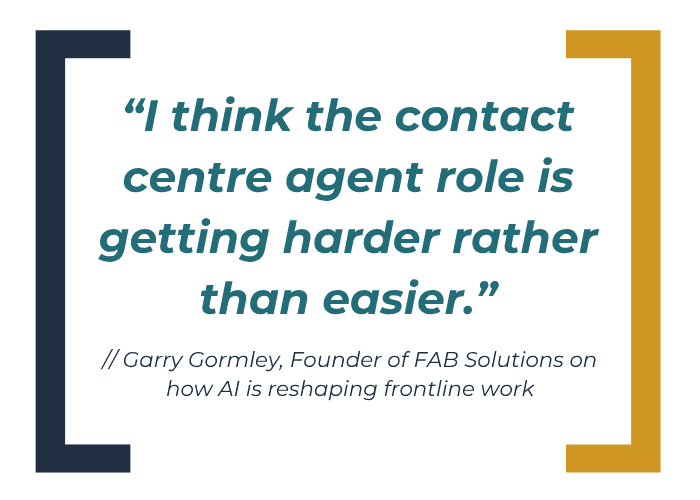
Garry Gormley agent quote

It sounds counterintuitive, if AI is doing more of the work, surely there should be less pressure on the humans? The problem is that AI isn’t necessarily removing work evenly. The interactions most suited to automation tend to be the predictable ones: straightforward requests, simple transactions and questions where an answer can be found relatively easily. What remains for humans is increasingly the work that is harder to automate.

Agents are dealing with “more complex, more emotional, more vulnerable customers”. They may be handling fewer simple enquiries, but spending a greater proportion of their day on conversations requiring judgement, empathy and a deeper understanding of individual circumstances.

This also challenges the idea of contact centre work as an entry-level role, something Garry argues it never really has been. Agents have always needed to listen and respond to customers while navigating systems, processes and policies at the same time. As AI removes more of the straightforward interactions, those existing demands don’t disappear; they become concentrated in the conversations left behind.

When the Easy Calls Disappear

Changing the mix of interactions reaching agents also changes what good performance looks like. Average handling time is an obvious example. If a contact centre previously handled a mixture of short transactional calls and longer complex conversations, removing many of those short calls will inevitably push the average upwards.

Yet organisations can introduce self-service and automation while continuing to judge the people who remain against measures designed for a very different mix of work.

// “If you’re using self service and you’re taking away all of those short calls, and then you’re still expecting your average handling time to stay the same, I think you’re deluded.”

A rising handling time could therefore tell two very different stories;

  • It might indicate an efficiency problem
  • But it could equally be evidence that automation is working exactly as intended.

If the simple interactions are being resolved elsewhere and humans are handling the conversations that require investigation, reassurance or judgement, taking longer isn’t necessarily a sign of poorer performance.

The same question applies to containment. If the success of an automated journey is measured by whether a customer reaches a human, escalation can easily look like failure. But someone dealing with a complicated problem, experiencing vulnerability or simply needing reassurance may be better served by a person. In those circumstances, recognising when a human is needed could be a sign that the technology is working well rather than badly.

As AI takes on more of the straightforward work, perhaps the bigger question isn’t simply how much it can automate, but whether organisations are adapting to what that leaves behind. If the human role increasingly begins where automation reaches its limits, the way agents are trained, supported and measured may need to change with it.

Image sources

  • Garry Gormley agent quote-700: ©Garry Gormley interview with Decoded Thinking
  • call-centre-1200: ©HRAUN from Getty Images Signature via Canva.com

Leave a Reply

Your email address will not be published. Required fields are marked *

© 2026 All Rights Reserved