The AI Adoption Organisations Can’t See

Much of the conversation around AI adoption focuses on helping employees embrace new technology. Organisations invest in training, launch pilot projects and encourage experimentation, often assuming the biggest challenge is persuading people to start using AI.
Yet during a recent conversation about leadership and organisational change, Natalie Calvert, Founder of HuddleCX shared a statistic that challenges that assumption.
According to the PagerDuty 2026 Shadow AI Survey, almost two-thirds (66%) of employees who use AI at work do so despite believing it isn’t permitted, while nearly 40% say they would rather continue using AI without telling anyone than risk being told to stop.
It’s a striking finding because it suggests many organisations may already have more AI adoption than they realise.
If employees are already using AI, but choosing not to talk about it, then the challenge may not be adoption at all. Instead, it may be one of trust.
When AI use remains hidden, organisations lose visibility of what’s actually happening. Valuable experimentation goes unnoticed, successful ways of working aren’t shared, and leaders are left making decisions without understanding how AI is already being used across the business.
The question isn’t simply whether employees are adopting AI. It’s whether organisations have created an environment where people feel comfortable talking about it.
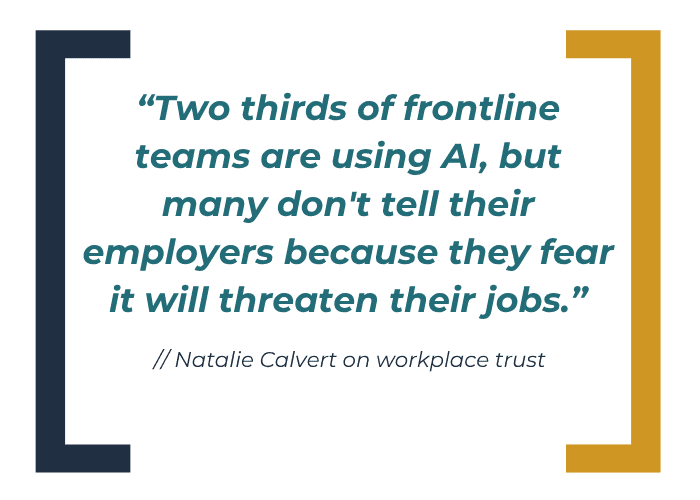
Natalie also pointed to research from Vanson Bourne’s State of Workforce Communication in the AI Era, which found that around half of frontline and contact centre employees are using AI tools their employer hasn’t approved.
Although the two studies look at different groups of employees, they point towards the same underlying issue. AI use is often happening beneath the surface, outside formal governance and without organisations fully understanding where, how or why it’s taking place.
The research doesn’t tell us why employees choose not to disclose their AI use. It may be uncertainty about company policy, concern over how AI use will be perceived or simply a lack of confidence in discussing it openly. Whatever the reason, organisations lose the opportunity to learn from the people who are already experimenting, discovering better ways of working and identifying where AI genuinely adds value.
That creates an interesting dilemma.
Many organisations are investing significant time and money encouraging AI adoption. Yet some of the most valuable learning may already exist inside the business, hidden because employees don’t feel comfortable discussing the tools they’re already using.
Rather than asking how to encourage people to adopt AI, perhaps organisations should first ask a different question: Have they created an environment where people feel safe enough to talk about how they’re already using it?
Image sources
- natalie calvert trust quote-700: ©Natalie Calvert interview with Decoded Thinking
- iceberg reflection-1200: ©ArcticDesire from pixabay via Canva.com