Decoded Thinking

Decoded Thinking

What Happens If Your AI Tools Disappear Tomorrow?

misty person

AI tools are quickly becoming part of everyday work. They summarise meetings, draft content, find information, analyse data and support decisions. For organisations, the appeal is obvious. But as AI becomes embedded into the way people work, Carolyn Jardmore, Managing Director of Cream Consulting, thinks businesses also need to consider what happens when the technology they’ve started relying on is no longer there.

During a recent Decoded Thinking webinar, Carolyn described four areas organisations should be thinking about as their use of AI grows: dependency, displacement, dysfunction and disaster recovery. Individually, each raises questions about how businesses are adopting AI. Together, they raise a bigger one about whether organisations could still operate if some of that technology suddenly disappeared.
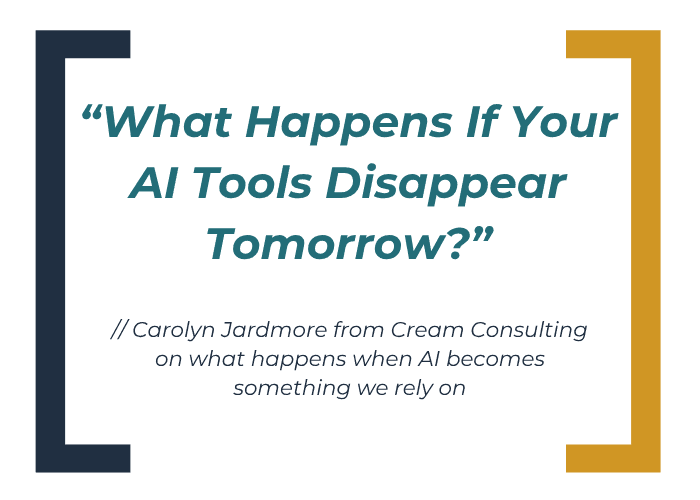
carolyn jardmore tool quote

When Useful Becomes Essential

An AI tool might initially be introduced because it makes a task quicker or easier. Over time, though, employees adapt the way they work around it, processes change and the technology gradually becomes something the organisation expects to have available. Carolyn suggests testing that dependency by asking what would happen if circumstances suddenly changed. “If pricing suddenly doubled overnight, what would that mean for you?”

That question is becoming more important as companies change how they charge for AI. From 2nd November, Microsoft will start charging for some extra Copilot features based on how much they are used. Put simply, the more a business uses them, the more it could pay.

That matters if people have already started relying on them. A tool might seem affordable when only a few people are using it, but the cost could grow as it becomes part of everyday work. If the price eventually becomes too high, could the business simply stop using it?

It doesn’t necessarily take a dramatic technology failure. A provider could change its pricing, alter its product or withdraw a service. An outage could temporarily remove access. The important question is whether people could continue doing the work without it, even if it took longer, or whether the technology has become so embedded that the process no longer really works without it.

The risk isn’t simply that the organisation becomes dependent on the technology. Over time, the people using it can become dependent too.

This is where Carolyn’s second area, displacement, becomes important. That doesn’t have to mean people losing their jobs. Individual tasks and skills can disappear from a role while the person remains, particularly when AI can perform parts of their work faster or more easily.

The immediate impact may be positive. People have less manual work to do and more time for other things. But if they stop performing a task themselves, they also stop practising the skills behind it. That loss may be difficult to see while the technology is working well. It becomes much more obvious if the organisation suddenly needs those skills again.

Could You Still Work Without It?

That question isn’t only about whether people remember how to perform a particular task. Carolyn’s third area is dysfunction: what happens to our own judgement as we become more accustomed to AI doing some of the thinking for us?

If a tool consistently provides useful answers, recommendations or summaries, it can become easy to accept what it gives us without questioning it quite as much. A human may still technically be involved in the process, but that means much less if they no longer have the confidence or expertise to recognise when the technology might be wrong.

That makes critical thinking, curiosity and challenge increasingly important as AI becomes part of everyday work. The distinction isn’t simply between a process completed by a human and one completed by AI. It’s whether the human involved is still actively applying their own judgement.

And then there is the practical question of what happens when the technology really isn’t available.

Businesses already plan for systems going down, but Carolyn argues that having a manual process written somewhere isn’t necessarily the same as being able to use it. “Is the person who wrote it still in the business?”

If employees haven’t performed a task manually for years, or the people who understood the original process have moved on, reverting to it may be much harder than a disaster recovery plan suggests. This is where dependency, displacement and disaster recovery start to overlap. Losing access to a tool is one problem, discovering at the same time that the organisation has lost the knowledge required to work without it is another.

What Do We Want To Keep?

None of this means organisations should avoid using AI or preserve every manual process indefinitely. Technology has always changed the way people work, and there would be little point introducing tools that make things faster or easier while insisting everyone continues doing everything exactly as they did before.

But perhaps adopting AI isn’t only about deciding what we’re happy for technology to take over, it also means deciding what we don’t want to lose.

  • There may be skills people need to keep practising, even if AI can perform the task more quickly.
  • There may be knowledge that needs to remain inside the organisation rather than becoming something nobody thinks about until a system goes down.
  • And there may be areas where human judgement needs to remain active rather than simply sitting somewhere in the process on paper.

That makes the four areas Carolyn identifies less about preparing for some dramatic future where every AI tool disappears at once, and more about understanding what is happening as organisations become increasingly reliant on them.

Image sources

  • carolyn jardmore tool quote-700: ©Carolyn Jardmore interview with Decoded Thinking

Image sources

  • carolyn jardmore tool quote-700: ©Carolyn Jardmore interview with Decoded Thinking

Leave a Reply

Your email address will not be published. Required fields are marked *

© 2026 All Rights Reserved